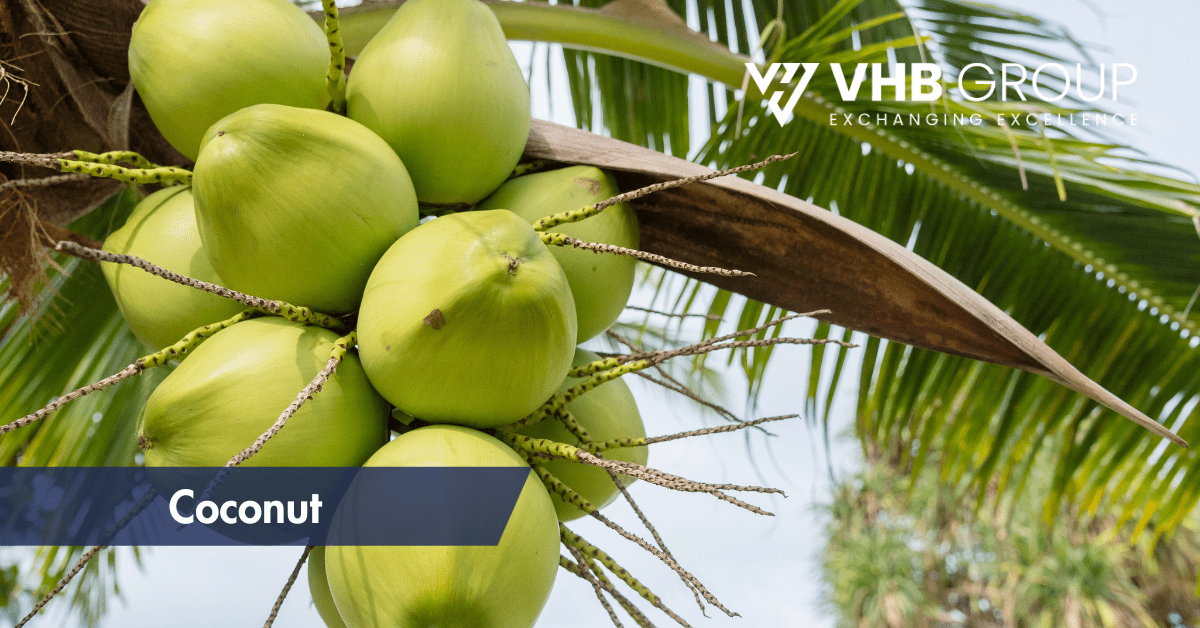
The Vietnamese coconut sector has emerged as a powerhouse in the global coconut market, rapidly transforming from a local crop to a multi-million dollar export success story. For international distributors and B2B buyers, this transformation presents a critical sourcing opportunity. Vietnam is now strategically challenging major competitors like Thailand, leveraging sophisticated processing and favorable logistics to capture significant market share, especially in key markets like the US and China.
The Exponential Growth of Vietnamese Coconut Exports
Vietnam’s coconut market is experiencing an unprecedented surge in export value, validating the country’s focused efforts to industrialize the sector.
Surging Export Figures
According to data from Vietnam Customs, coconut became one of the country’s top six most valuable exported fruits. In September, fresh fruit exports alone reached over $41 million, marking a 19% increase year-over-year. Cumulatively, Vietnam earned over $131 million from the fresh produce in the first nine months of the year, a 17% rise compared to the same period in 2024.
Beyond fresh produce, Vietnam successfully exports over 100 processed products derived from the crop, including oil, canned water, and desiccated meat, to dozens of countries and territories. Processed goods generated nearly $260 million in export turnover during the nine-month period, demonstrating a substantial 55% over the previous year.
Key Global Coconut Markets Fueling Demand
The US currently stands as Vietnam’s largest coconut market, driving nearly 26% of total export turnover. Major retail chains and the booming beverage industry fuel this strong demand, where Vietnamese produce is highly favored.
China ranks as the second-largest coconut market, exhibiting rapidly growing import volumes. Additionally, several other destinations, including Sri Lanka, Spain, Puerto Rico, Australia, and Cambodia, have significantly increased their imports of the Vietnamese coconut market with growth rates multiplying two to three times.
Achieving a Billion-Dollar Status
The coconut has long been tied to the culture of Southern Vietnam. After more than a decade of effort by local governments, enterprises, and the Vietnam Coconut Association, this fruit has affirmed its new position, holding the potential to join the nation’s group of billion-dollar agricultural exports.
Historically, coconut lacked a position on the export map ten years ago. Through focused efforts, the export turnover for the industry reached approximately $1 billion by 2024. Furthermore, in early 2024, the coconut was officially included in the group of key national industrial crops development plan.
Strategic Advantages and Industry Modernization
The rapid ascendancy of the Vietnamese coconut market is rooted in strategic national policy, industry modernization, and competitive advantages.

National Priority and Cultivation Hubs
The government’s commitment is clear: Vietnam places coconut among its six key industrial crops, ensuring special support regarding land use, credit, and trade promotion.
The industry is highly concentrated. Following administrative consolidation, Vĩnh Long province now boasts an area of nearly 120,000 hectares, representing over 50% of the country’s total coconut cultivation (approximately 22 million trees), making it a key crop
for the province. On average, nearly 270,000 coconut farming households in Vĩnh Long earn a stable income of 100-150 million VND per hectare annually.
Value-Added Processing and Product Diversification
The industry’s transformation is driven by the development of over 250 processing facilities, with 80 enterprises specializing in deep processing. The emergence of large-scale coconut farms further boosts stability.
Specialty varieties, like Dừa Xiêm (Siamese, which is known for its distinctive sweet and refreshing flavor, have received Geographical Indication certification in Bến Tre. Furthermore, products derived from its husks, leaves, and coir are opening up vast potential in the processing and handicraft industries.
Logistical Supremacy in the Asia Market
Vietnam’s geographical proximity to China provides a critical logistical advantage, significantly reducing transit times and lowering shipping costs. This proximity gives Vietnamese coconut a clear competitive edge over rivals, particularly Thailand.
Mr. Tattawin Saruno, an independent scholar and expert in Thai agricultural management, stated: “The Chinese market, which previously relied heavily on Thai supply, has now shifted strongly toward imports from Vietnam.” The export of fresh and processed coconut to China has increased by hundreds of percent just in 2025, solidifying Vietnam’s position as Asia’s rising supply source.
Facing Challenges and Future Outlook
Despite its remarkable growth, the Vietnamese industry faces several challenges, including reliance on traditional farming practices, the impact of climate change, vulnerability to pests, and market price fluctuations. However, the global market for the product is projected for massive expansion, expected to increase from $3.5 billion in 2023 to $8.2 billion by 2032. As the world’s 7th largest producer of this nut, Vietnam is strategically capitalizing on this surge.
The Vietnamese coconut market is delivering on its billion-dollar potential. Secure your competitive edge with a reliable supply of high-quality fresh and processed coconut products. Contact us today to discuss your large-volume sourcing needs.
I am text block. Click edit button to change this text. Lorem ipsum dolor sit amet, consectetur adipiscing elit. Ut elit tellus, luctus nec ullamcorper mattis, pulvinar dapibus leo.