

Sourcing premium agricultural products requires a deep understanding of their cultivation roots, which is why identifying a reliable High Fat Desiccated Coconut Origin is crucial for global food manufacturers. As a highly versatile ingredient prized in the confectionery, bakery, and dairy industries, desiccated coconut provides not only rich flavor but also essential structure and texture. Finding an origin that balances high-lipid content, strict hygiene protocols, and ethical supply chains is the key to unlocking consistent product quality. In the competitive B2B food sector, procurement managers must analyze the geographical, biological, and technical aspects of their raw materials to maintain a resilient supply chain.
Table of Contents
- Understanding the High Fat Desiccated Coconut Origin and Global Market Dynamics
- Vietnam as a Premier High Fat Desiccated Coconut Origin
- Advanced Processing Methods: From Harvest to High-Fat Grates
- International Quality Standards and Certifications
- Technical Specifications and Grading Criteria
- B2B Export Packaging and Supply Chain Integrity
- Why Partner with VIHABA for Sourcing High Fat Desiccated Coconut Origin
- Frequently Asked Questions (FAQs)
Understanding the High Fat Desiccated Coconut Origin and Global Market Dynamics
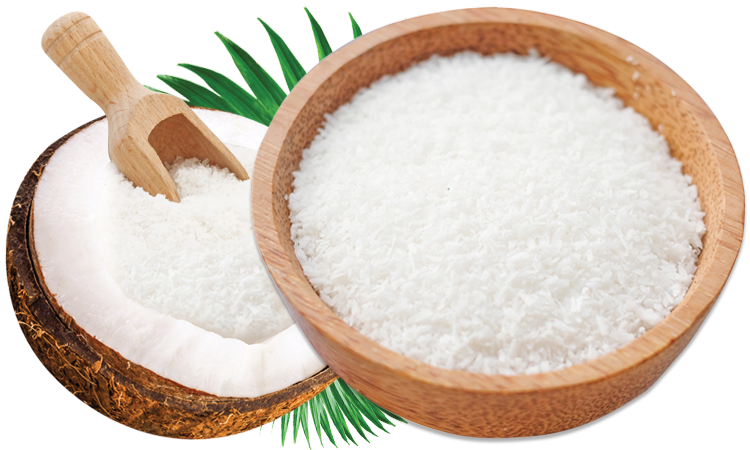
The global demand for coconut-based ingredients has witnessed exponential growth over the past decade. Among these ingredients, high fat desiccated coconut stands out due to its high fat content (minimum 65%), which makes it an exceptional flavor carrier and texturizer. Unlike low-fat alternatives, which are often the by-product of coconut milk extraction, high fat desiccated coconut retains the natural, rich oils of the coconut endosperm. Sourcing from a verified High Fat Desiccated Coconut Origin ensures that the raw material has not been pre-pressed, maintaining its full nutrient profile, creamy mouthfeel, and rich aroma.
In the international trade landscape, Southeast Asia dominates the production of coconut products. Countries like Indonesia, the Philippines, and Vietnam are at the forefront of the supply chain. However, as global B2B buyers seek greater resilience and risk mitigation in their supply chains, Vietnam has emerged as a particularly attractive High Fat Desiccated Coconut Origin. The country combines fertile geographical advantages with modern processing infrastructure, offering an excellent alternative that meets and often exceeds traditional sourcing hubs. For global food manufacturers and wholesalers seeking the finest grade of ingredients, establishing a partnership with an authentic High Fat Desiccated Coconut Origin guarantees access to premium-grade, lipid-rich coconut shreds that elevate the texture and flavor of confectionery, bakery, and culinary products.
From an economic standpoint, the choice of origin affects not only the physical quality of the product but also import tariffs, shipping lead times, and compliance with pesticide residue limits. By understanding the agricultural and macro-economic factors that govern each production region, international buyers can make highly strategic procurement decisions that optimize their margins and protect their brand reputation.
Vietnam as a Premier High Fat Desiccated Coconut Origin
When analyzing Vietnam as a High Fat Desiccated Coconut Origin, one must look closely at the unique geography of the Mekong Delta, specifically Ben Tre province. Known globally as the ‘Coconut Capital’ of Vietnam, Ben Tre boasts over 70,000 hectares of coconut plantations. The region’s unique ecosystem, characterized by rich alluvial soil deposited by the Mekong River branches, high humidity, and year-round abundant sunshine, provides the perfect environment for coconut palms to thrive.
The specific soil salinity and mineral content in the Mekong Delta trigger a natural lipid biosynthesis pathway in the coconut endosperm. This biological phenomenon results in coconuts with exceptionally thick, dense meat containing high concentrations of medium-chain triglycerides (MCTs), primarily lauric acid. This naturally high fat content is what makes Vietnamese coconuts uniquely suited for high-fat desiccation. While exploring premium agricultural raw materials like Vietnamese Cassia Cinnamon or high-grade Vietnamese Star Anise, international B2B buyers have increasingly recognized Vietnam’s capability to supply top-tier coconut products that meet stringent global parameters.
Moreover, Vietnamese agricultural practices have undergone rapid modernization. Government initiatives and agricultural cooperatives in Ben Tre have heavily promoted organic farming methods, minimizing the use of synthetic chemical inputs. This focus on sustainability ensures that the coconut palms grow healthily over their long lifespans, producing kernels that are chemically pure and highly stable. Consequently, Vietnam has solidified its position as a high-quality High Fat Desiccated Coconut Origin that can fulfill the rigorous chemical and biological compliance demands of demanding markets like Europe and North America.
Advanced Processing Methods: From Harvest to High-Fat Grates
Transforming raw coconuts into premium desiccated shreds is a highly sophisticated technological process. Maintaining the natural fat content without allowing the delicate oils to oxidize requires strict temperature controls and hygienic processing lines. At a premier High Fat Desiccated Coconut Origin, the manufacturing process is executed through a sequence of carefully monitored steps:
1. Harvesting and De-husking
Coconuts are harvested at optimal maturity, typically between 11 to 12 months, when the fat content in the kernel is at its peak. Sourcing immature coconuts would lead to a lower oil yield and a softer texture, which is unsuitable for high-quality desiccation. The outer fibrous husk is removed at the farm level, and the de-husked nuts are transported swiftly to the processing facility to prevent fermentation and spoilage.
2. De-shelling and Paring
At the factory, the hard inner shell is carefully cracked open. Skilled workers perform ‘paring’, which is the precise removal of the thin, brown outer skin (testa) of the coconut meat. This step is critical; any trace of the brown testa left on the kernel will result in dark specks in the final desiccated product, degrading its quality class. The pared kernels are immediately placed in clean water to prevent enzymatic browning.
3. Blanching and Sterilization
The pristine white coconut meat is washed thoroughly in clean, treated water and then subjected to steam blanching. This pasteurization process utilizes high-temperature steam (typically 80°C to 90°C) for 3 to 5 minutes to eliminate potential microbiological hazards, such as Salmonella and E. coli, ensuring the product is completely safe for direct consumption. This step also deactivates enzymes like lipase and polyphenol oxidase, which would otherwise degrade the fats and cause rancidity or yellowing over time.
4. Disintegration and Shredding
Once sterilized, the coconut meat is fed into industrial disintegrators or cutters. Depending on the target specification, the meat is shredded into various sizes, primarily ‘Fine’ (small, granular particles) or ‘Medium’ (larger, thread-like shreds). The cutter blades must be extremely sharp to ensure clean cuts, preventing the oil from being prematurely squeezed out of the cells, which would cause the shreds to clump and spoil.
5. Fluidized Bed Drying
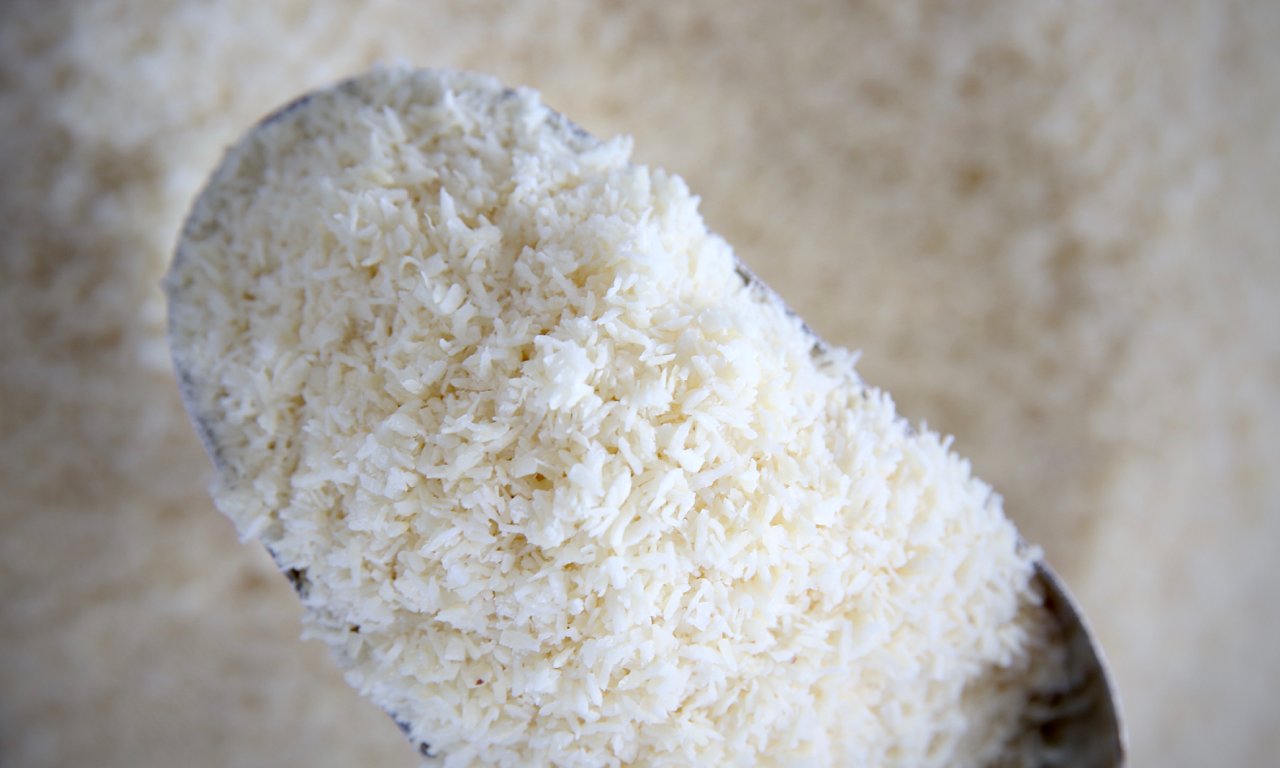
The shredded wet coconut is immediately transferred to a fluidized bed dryer. Here, hot air is passed through the bed of coconut shreds, lifting and drying them uniformly. The temperature is strictly regulated (usually around 70°C to 80°C) to dry the product to a moisture content of under 3%. Precise drying prevents heat damage or discoloration, preserving the snow-white color and preventing the oils from turning rancid during storage.
6. Sifting, Cooling, and Metal Detection
After drying, the desiccated coconut is cooled to ambient temperature to stop the cooking process. It then passes through vibratory sieves to ensure uniform particle size distribution according to buyer specifications. Before packaging, every batch passes through high-sensitivity industrial metal detectors to guarantee physical purity, protecting end consumers and processing machinery alike.
International Quality Standards and Certifications
To operate as a trusted global High Fat Desiccated Coconut Origin, processing facilities must comply with rigorous international food safety management systems. B2B buyers in Europe, North America, and the Asia-Pacific region demand absolute traceability and quality assurance. Modern Vietnamese coconut processing factories hold comprehensive certifications to satisfy these demands:
- HACCP & ISO 22000: These foundational hazard analysis and food safety management systems ensure that every step of the production process—from raw material receipt to final shipment—is monitored for biological, chemical, and physical hazards.
- BRCGS & IFS: British Retail Consortium Global Standards and International Featured Standards certifications demonstrate a factory’s commitment to senior management responsibility, hazard analysis, and product quality control at a global retail standard.
- Halal & Kosher: Dietary compliance is crucial for global market penetration. Vietnamese exporters work closely with recognized Islamic and Jewish certification bodies to audit production lines, ensuring no cross-contamination occurs and that all processing aids are compliant.
- Social Compliance (SEDEX/SMETA): Ethical sourcing is no longer optional. Leading processing units undergo independent audits to verify fair labor practices, safe working conditions, and environmental responsibility, assuring buyers of a clean and ethical supply chain.
Technical Specifications and Grading Criteria
When procurement teams evaluate a High Fat Desiccated Coconut Origin, the technical data sheet (TDS) serves as the primary benchmark. High fat desiccated coconut is generally classified into Fine and Medium grades based on particle size. Below is a comprehensive data specification table representing the industry standards for premium Vietnamese high fat desiccated coconut:
| Parameter | Fine Grade Specification | Medium Grade Specification |
|---|---|---|
| Fat Content | Min 65% | Min 65% |
| Moisture | Max 3.0% | Max 3.0% |
| Free Fatty Acids (FFA as Lauric) | Max 0.3% | Max 0.3% |
| pH (10% dispersion) | 6.1 – 6.7 | 6.1 – 6.7 |
| Sulfur Dioxide (SO2) | Free or Max 100 ppm (as per customer request) | Free or Max 100 ppm (as per customer request) |
| Sieve Analysis | 90% passing through 1.4mm mesh | 90% passing through 2.8mm mesh |
| Salmonella | Negative in 25g | Negative in 25g |
| E. coli | Negative in 1g | Negative in 1g |
| Total Plate Count (TPC) | Max 5,000 cfu/g | Max 5,000 cfu/g |
| Organoleptic | Mild, sweet, natural coconut flavor; snow-white color | Mild, sweet, natural coconut flavor; snow-white color |
B2B Export Packaging and Supply Chain Integrity
Even the highest quality desiccated coconut can degrade rapidly if the packaging and logistics chains are compromised. Because of the high lipid content, the product is highly susceptible to moisture absorption, rancidity (due to lipid oxidation), and pest infestation. Therefore, high-specification packaging is mandatory at any reputable High Fat Desiccated Coconut Origin.
Standard export packaging consists of multi-wall Kraft paper bags (usually 3 to 4 plies) with a food-grade inner polyethylene (PE) liner. These bags are hermetically sealed to prevent moisture and oxygen ingress. Typical bag sizes are 25 kg, 50 lbs, or custom jumbo bags (up to 500 kg) for high-volume industrial manufacturers. To maintain supply chain integrity during maritime transit, containers must be thoroughly inspected before loading. They must be dry, odorless, and free from condensation. Desiccant bags or silica gel poles are placed inside the container to manage humidity levels during transit across varying climate zones, ensuring the cargo arrives at the destination port in pristine condition.
Furthermore, shipping lines must be selected carefully to minimize transit times, especially when shipping to distant markets in Europe or North America. Prolonged exposure to high ambient temperatures in tropical shipping lanes can accelerate FFA development. Trusted exporters work with reputable carriers to ensure that transit times are minimized and container storage on vessels is optimized away from direct heat sources.
Why Partner with VIHABA for Sourcing High Fat Desiccated Coconut Origin
VIHABA has established itself as a premier partner in the agricultural commodities export sector from Vietnam. Our deep integration into the local farming communities and advanced manufacturing alliances positions us as a highly dependable supplier for global buyers seeking a reliable High Fat Desiccated Coconut Origin.
When you choose VIHABA, you gain several distinct advantages:
- Direct Farm Sourcing: We work directly with cooperative farmers in Ben Tre, ensuring fair pricing for growers and complete traceability of raw coconuts back to their specific harvesting plots. This direct connection also helps us promote sustainable farming methods among our growers.
- Rigorous Quality Control: Our dedicated quality assurance teams supervise the entire processing run, conducting batch testing for moisture, fat content, and microbiological safety prior to dispatch. No container leaves the factory without a comprehensive Certificate of Analysis (CoA).
- Tailored Solutions: Whether you require sulfur-free organic desiccated coconut, specific particle sizes, or customized packaging designs, VIHABA provides the flexibility needed to fit your exact production line requirements.
- Seamless Logistics Support: From handling complex export documentation and customs clearance in Vietnam to arranging competitive ocean freight rates, our logistics experts handle the heavy lifting to ensure on-time delivery to your warehouse.
Through our commitment to quality, transparency, and customer satisfaction, VIHABA has built long-term relationships with food manufacturing brands worldwide. We understand that your success depends on the consistency of your raw materials, and we treat every shipment with the highest level of professionalism.
Conclusion: Securing Your High Fat Desiccated Coconut Origin with VIHABA
Selecting the right High Fat Desiccated Coconut Origin is a strategic business decision that directly impacts the quality, flavor, and consumer appeal of your final products. Vietnam’s Mekong Delta, with its nutrient-rich alluvial soil and ideal climate, provides an unparalleled environment for cultivating coconuts with the superior fat profiles required by modern food manufacturers. By combining these natural geographical advantages with state-of-the-art processing, rigorous international quality certifications, and secure export logistics, Vietnam stands out as a world-class source.
As your trusted trade partner, VIHABA is committed to delivering the highest caliber of agricultural products directly from the source. Our focus on transparency, product safety, and reliable supply chain execution makes us the ideal choice to secure your high fat desiccated coconut needs. Contact VIHABA today to request product samples, receive custom price quotes, and elevate your B2B sourcing strategy to new heights.
High Fat Desiccated Coconut Origin FAQ
Disclaimer: Unless otherwise stated, the images used in this article are the property of their respective owners. We do not claim ownership of any third-party images featured, and they are used here strictly for informational and educational purposes. If you are the copyright holder and wish to have an image removed, please contact us.