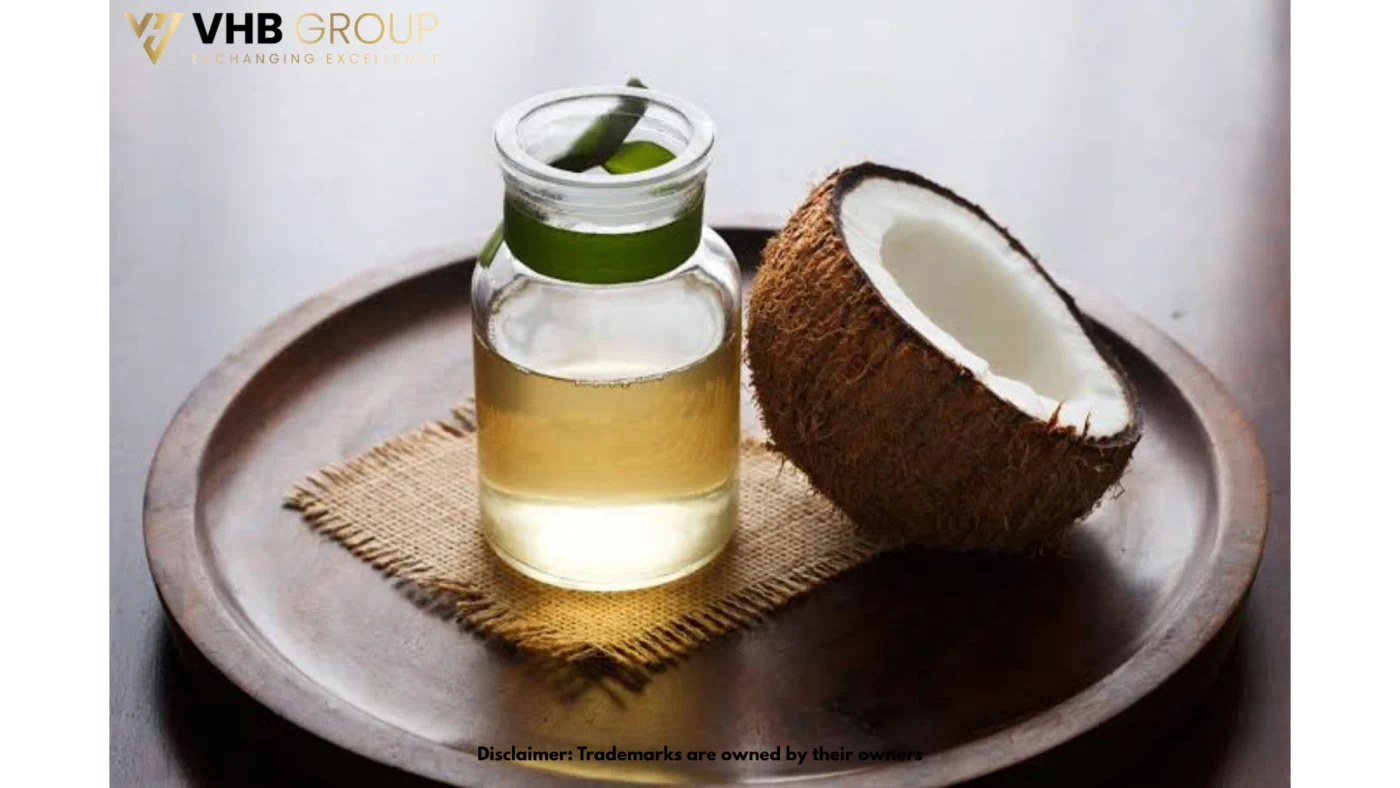
Exploring Fractionated Coconut Oil Origin parameters provides personal care importers, pharmaceutical formulators, cosmetic brand owners, and retail supply managers with deep insights into how harvest geography, raw coconut sourcing, molecular fractionation technology, and regional refining networks in Southeast Asia govern finished product quality. While fractional distillation isolates pure Caprylic (C8) and Capric (C10) medium-chain triglycerides, the chemical yield and purity of the process trace directly back to the quality of raw coconuts harvested at origin.
Evaluating origin parameters allows procurement directors at VHB Group to secure origin-traceable supply chains, optimize C8/C10 yield, and satisfy strict European Union Deforestation Regulation (EUDR) mandates.
Table of Contents
-
Global Coconut Harvesting Geography and Feedstock Sourcing
-
The Agronomy of Mature Coconuts and Lipid Content
-
Industrial Fractional Distillation Infrastructure at Origin Refining Hubs
-
Southeast Asian Processing Hubs: Vietnam’s Mekong Delta Benchmark
-
Regional Sourcing Comparison Matrix
-
European Union Deforestation Regulation (EUDR) Traceability
-
Frequently Asked Questions (FAQ)
1. Global Coconut Harvesting Geography and Feedstock Sourcing
Coconut palms (Cocos nucifera) flourish across tropical coastal zones located between 15 degrees North and 15 degrees South of the Equator. Southeast Asia accounts for over 80% of global commercial coconut production, led by Indonesia, the Philippines, and Vietnam.
[Mekong Alluvial Silt Soils] ──► [High-Yield Mature Coconut Palms]
                                              │
                                              ▼
[Crude Coconut Oil Extraction] ──► [Physical Fractional Vacuum Distillation]
                                              │
                                              ▼
[Pure C8/C10 Fractionated Liquid Oil (MCT)]
The chemical efficiency of industrial fractionation depends on sourcing high-purity crude coconut oil derived from mature coconuts grown in mineral-rich alluvial soils.
2. The Agronomy of Mature Coconuts and Lipid Content
To maximize the yield of medium-chain fatty acids, raw coconuts must be harvested at full physiological maturity:
Nut Maturation Cycle (11 to 12 Months)
Coconuts harvested at 7 to 9 months (young green coconuts) contain high water volume but thin endosperm with low fat density. For optimal oil extraction, nuts must remain on the palm for 11 to 12 months until the outer husk turns brown. At full maturity, kernel dry-matter fat content reaches its peak of 65% to 68%.
Crude Oil Quality and Free Fatty Acid Control
Harvested mature nuts are de-husked, dried into copra, and pressed to yield crude coconut oil. Origin processing facilities enforce strict copra drying protocols (lowering moisture below 6%) to prevent fungal mold (Aspergillus) from raising free fatty acids. Low-acid crude oil (FFA under 1.5%) is essential for high-yield fractional distillation.

3. Industrial Fractional Distillation Infrastructure at Origin Refining Hubs
Converting raw coconut oil into high-purity C8/C10 fractionated oil requires sophisticated multi-million dollar chemical processing infrastructure:
-
High-Pressure Fat Splitting: Steam hydrolysis reactors split crude coconut oil into free fatty acids and glycerin at 250°C and 50 bar pressure.
-
Multi-Stage Vacuum Distillation Columns: Fractionating towers standing over 30 meters tall separate individual fatty acids based on boiling point differentials under deep vacuum (1 to 5 mbar).
-
Re-Esterification Reactors: Stainless steel batch reactors combine isolated C8 and C10 fractions with refined glycerol, utilizing specialized catalysts to form medium-chain triglycerides.
-
Deodorization and Filtration: Steam deodorization towers strip volatile odor compounds at 200°C, followed by sub-micron carbon filtration to yield water-clear liquid oil.
4. Southeast Asian Processing Hubs: Vietnam’s Mekong Delta Benchmark
Vietnam’s Ben Tre province, located in the Mekong Delta, represents one of Asia’s most advanced coconut production and processing centers, known internationally as the “Coconut Capital of Vietnam.”
Alluvial Soil Mineral Richness
Ben Tre benefits from rich alluvial soil deposited continuously by nine branches of the Mekong River system. This nutrient-dense soil nurtures coconut palms that yield heavy nuts with thick, high-fat kernels.
Modern Origin Fractionation Facilities
VHB Group operates integrated origin sourcing networks in Ben Tre equipped with modern fractional distillation columns, automated re-esterification reactors, and in-house gas chromatography (GC) testing laboratories. Processing fresh coconuts locally guarantees C8/C10 fractionated oil testing consistently below 0.10% FFA and 0.5 meq/kg peroxide value.
5. Regional Sourcing Comparison Matrix
The following matrix compares primary regional origin hubs for fractionated coconut oil across Southeast Asia:
| Sourcing Origin Hub | Agronomic Characteristics | Distillation Technology | Typical C8:C10 Ratio | Primary Commercial Best-Fit |
| Vietnam (Ben Tre) | Rich Mekong alluvial soil, high potassium | Multi-Stage Vacuum Distillation | Customized (60:40 / 70:30) | Luxury Cosmetics, Pharma & CBD Carrier |
| Indonesia (Sumatra) | Volcanic and coastal sandy loam | Continuous Fractionation Towers | Standard 60:40 | Mass Food Processing & Industrial Lubricants |
| Philippines (Mindanao) | Coastal tropical plains, high rainfall | Multi-Column Distillation | Standard 60:40 | Personal Care Formulations & Food Release |
6. European Union Deforestation Regulation (EUDR) Traceability
Because coconut farming across Southeast Asia is anchored by millions of smallholder farming families owning small plots (under 2 hectares), establishing supply chain transparency is critical for global market entry.
Under EUDR mandates, importers bringing coconut products into the European Union must provide precise polygon geolocation coordinates for the farm plots where coconuts were harvested. This data proves that the crop did not cause deforestation or forest degradation after December 31, 2020. VHB Group maintains full GPS farm mapping across partner cooperatives in Ben Tre, Vietnam.
Fractionated Coconut Oil Origin FAQ
Disclaimer: Unless otherwise stated, the images used in this article are the property of their respective owners. We do not claim ownership of any third-party images featured, and they are used here strictly for informational and educational purposes. If you are the copyright holder and wish to have an image removed, please contact us.