
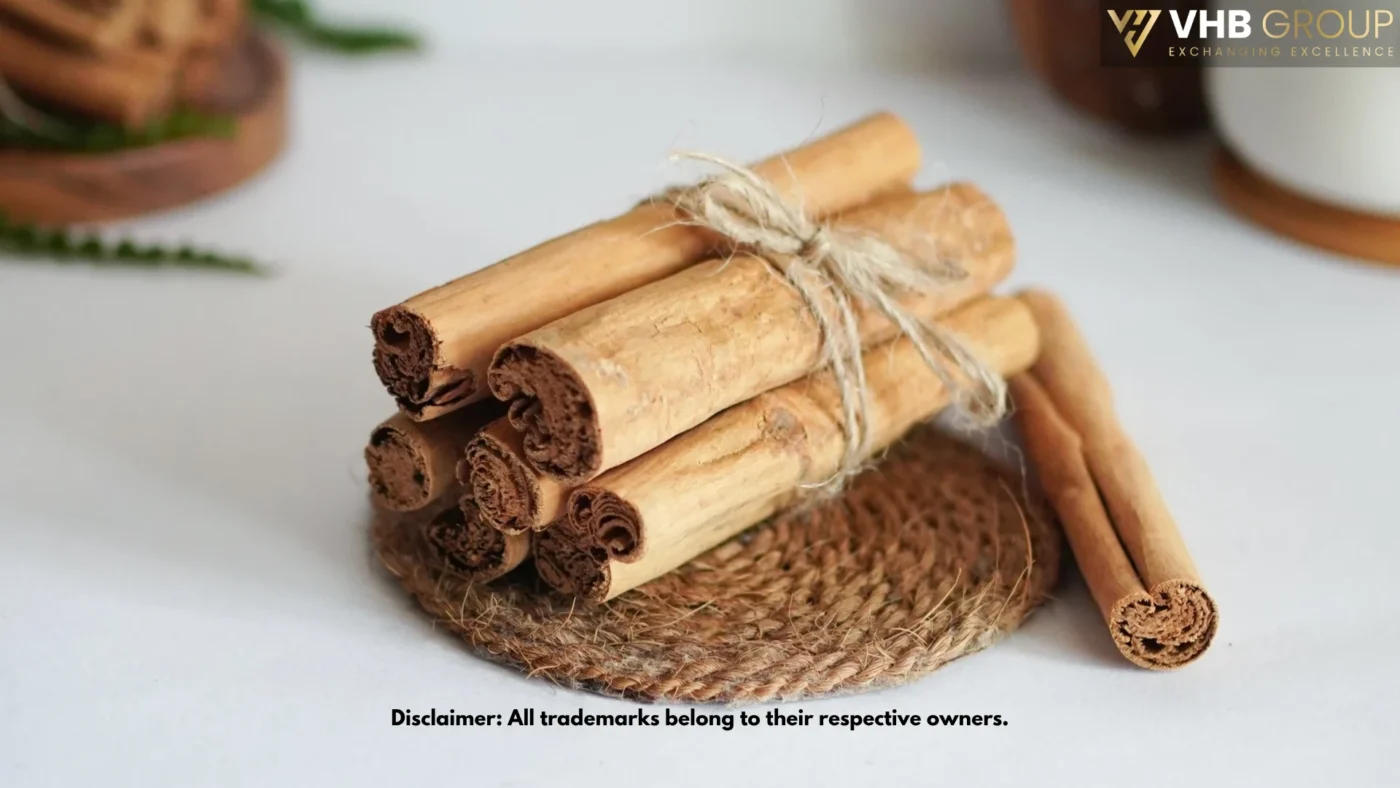
Understanding Double Rolled Cinnamon Sticks Rolling Facts is essential for commercial spice buyers seeking to justify premium price points and verify product quality. As detailed in our master guide on Double Rolled Cinnamon Sticks Export, crafting the perfect cinnamon quill involves complex manual techniques, exact moisture control, and precise curing stages. This labor-intensive process sets double rolled sticks apart from mass-produced flat bark or irregular splits.
In this deep dive, VHB Group explores the harvesting timing, epidermal scraping, manual rolling mechanics, and solar fixing processes required to produce premium cigar-cut cinnamon sticks.
Table of Contents
Harvesting Timing: The Importance of Bark Moisture
The foundation of Double Rolled Cinnamon Sticks Rolling Facts lies in harvesting timing. Cassia bark can only be rolled successfully if it contains the correct level of natural tree sap (moisture).
Source: Image courtesy of Wikimedia Commons
-
Seasonal Harvest Windows: Bark is harvested exclusively during the active sap flow seasons (spring and autumn). During these periods, the inner phloem is soft, pliable, and rich in volatile essential oils.
-
Tree Age Selection: Processors select medium-aged trees (8 to 12 years). Younger trees lack flavor depth, while older trees produce bark that is too thick and brittle to roll tightly.
Epidermal Scraping: Prepping the Phloem Layer
Before rolling, the rough, greyish outer cork (epidermis) must be completely removed.
Source: Image courtesy of Wikimedia Commons
Using specialized curved draw-knives, artisans shave away the outer layer. This process is critical for two reasons:
-
It removes epiphytic lichen, soil dust, and mold spores, reducing the total microbial load.
-
It exposes the smooth, reddish-brown inner bark containing the highest concentrations of cinnamaldehyde (often exceeding 3.5%).
For more chemical data on cinnamaldehyde properties, refer to Wikipedia’s Cinnamaldehyde entry.

The Manual Rolling Process: Crafting the Double Curl
Rolling cinnamon requires exceptional manual dexterity.
Source: Image courtesy of Wikimedia Commons
-
Sizing the Bark: The scraped bark is cut into precise rectangular sheets.
-
The Double Curl: While the bark is still moist and highly flexible, artisans manually curl both lateral edges inward toward the center axis.
-
Tension Control: The bark must be rolled tightly enough to form a compact double cylinder (quill) without snapping the cellular fibers.
Solar Curing and Shape Fixing Thermodynamics
Once rolled, the bark must be “fixed” into its permanent shape through controlled dehydration.
| Curing Stage | Objective | Environmental Control | Duration |
| Phase 1: Shade Fixing | Lock the rolled shape without rapid shrinkage | Indoor drying racks, high ambient humidity | 24 to 48 hours |
| Phase 2: Solar Dehydration | Evaporate internal moisture safely | Outdoor raised racks, direct/indirect sunlight | 3 to 5 days |
| Phase 3: Stabilization | Reach equilibrium moisture (below 13.5%) | Climate-controlled warehouse storage | 7 to 10 days |
Improper drying causes the rolled sticks to unravel or crack. VHB Group’s stringent curing protocols ensure the sticks maintain structural integrity through global supply chains, satisfying strict import regulations enforced by agencies like the U.S. Food and Drug Administration (FDA).

Double Rolled Cinnamon Sticks Rolling FAQ
Disclaimer: Unless otherwise stated, the images used in this article are the property of their respective owners. We do not claim ownership of any third-party images featured, and they are used here strictly for informational and educational purposes. If you are the copyright holder and wish to have an image removed, please contact us.