

Building a resilient and efficient Organic Desiccated Coconut Distribute Channel is essential for B2B buyers, food manufacturers, and global distributors looking to capitalize on the booming organic health-food sector. As global consumer demand shifts dramatically toward clean-label ingredients, plant-based diets, and certified organic alternatives, sourcing high-quality raw materials is no longer just a purchasing decision—it is a core strategic advantage. For international enterprise buyers, establishing a direct, transparent, and certified supply chain for desiccated coconut is the key to maintaining brand reputation, ensuring product consistency, and optimizing landed costs.
Table of Contents
- 1. Global Market Overview: The Surge in Organic Coconut Demand
- 2. Choosing the Right Organic Desiccated Coconut Distribute Channel
- 3. Vietnam’s Coconut Cultivation: Sourcing from Ben Tre Province
- 4. Industrial Processing Methods & Quality Preservation
- 5. Product Specifications and Grading Standards
- 6. International Certifications & Supply Chain Compliance
- 7. B2B Packaging, Shelf-Life, and Shipping Logistics
- 8. Frequently Asked Questions (FAQ)
- 9. Conclusion: Partnering with VIHABA for Global Supply Chain Excellence

1. Global Market Overview: The Surge in Organic Coconut Demand
The global market for organic coconut derivatives has experienced double-digit compound annual growth over the past decade. Driven by the expansion of the vegan food market, gluten-free baking trends, and the confectionery industry, desiccated coconut has transitioned from a niche bakery ingredient to a mainstream industrial staple. Unlike conventional coconut products, certified organic desiccated coconut is produced without synthetic fertilizers, chemical pesticides, or sulfur dioxide bleaching agents, making it highly sought after by clean-label food brands in Europe, North America, and the Asia-Pacific region.
For B2B importers, the primary challenge is not finding demand, but securing a stable, year-round supply of high-grade organic raw materials. The global supply chain is highly concentrated in tropical regions, with Southeast Asian nations leading global export volumes. To mitigate risks related to price volatility, climate disruptions, and shipping delays, experienced procurement managers are shifting from spot-buying on open markets to establishing structured, long-term supply partnerships via dedicated distribution channels.
2. Choosing the Right Organic Desiccated Coconut Distribute Channel
When structuring your supply chain, selecting the most direct and reliable Organic Desiccated Coconut Distribute Channel is the single most critical factor in controlling costs and verifying product authenticity. B2B buyers typically choose between three main distribution frameworks, each with distinct advantages and trade-offs:
Direct Sourcing from Origin Exporters
Sourcing directly from tier-one processors and exporters like VIHABA allows international buyers to eliminate intermediaries, secure the lowest possible FOB (Free on Board) prices, and establish complete traceability back to the organic farming cooperatives. This direct channel facilitates custom product tailoring (such as specific fat content levels, moisture tolerances, and cut sizes) and ensures immediate access to factory-level quality assurance documentation.
Regional Importers and Domestic Distributors
For small to medium-sized enterprises (SMEs) that cannot meet Full Container Load (FCL) requirements, domestic or regional distributors offer localized warehousing, shorter lead times, and customs clearance services. However, this channel introduces multi-tiered markups, limits direct control over batch traceability, and increases the risk of shelf-life degradation due to extended warehouse storage under varying environmental conditions.
Brokerage and Trading Agencies
Brokers can assist in sourcing volume during global shortages but often lack deep integration with processing facilities. This separation can lead to communication gaps regarding organic certification compliance, physical quality discrepancies, and a lack of transparency during supply chain audits. For premium organic brands, relying on brokers poses a compliance risk that can jeopardize organic certifications at the retail destination.
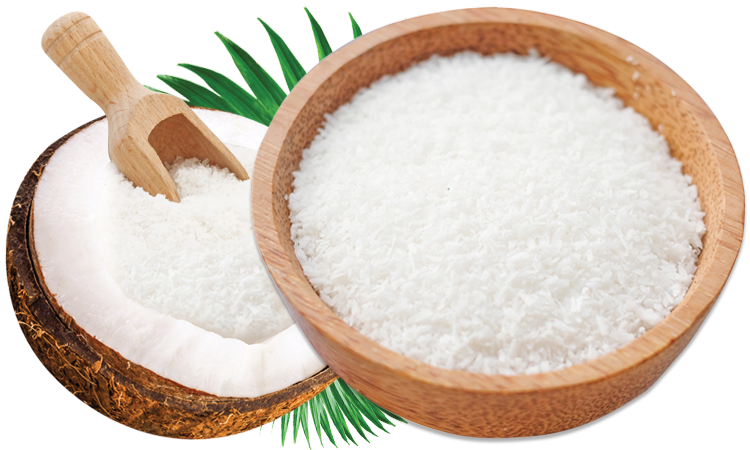
3. Vietnam’s Coconut Cultivation: Sourcing from Ben Tre Province
Vietnam has emerged as a premier global hub for high-quality organic coconut production, with Ben Tre Province serving as the epicenter of this agricultural success. Situated in the fertile Mekong Delta, Ben Tre benefits from a unique alluvial soil composition, rich river nutrients, and a stable tropical climate characterized by high humidity and consistent year-round sunshine. These geographic factors produce coconuts with superior oil profiles, high natural sweetness, and a rich, aromatic flavor profile that is highly prized in the desiccated coconut industry.
To support the global Organic Desiccated Coconut Distribute Channel, Vietnamese farmers, in partnership with exporter networks like VIHABA, have converted thousands of hectares of coconut groves into certified organic farmlands. These farms strictly adhere to international organic farming practices, including:
- Zero Chemical Pesticides: Utilizing biological pest control methods, such as releasing beneficial insects, to manage natural pests without chemical intervention.
- Natural Fertilization: Relying exclusively on organic compost, river silt deposits, and green manure to nourish the coconut palms.
- Biodiversity Maintenance: Intercropping coconut groves with cocoa, bananas, and local fruit trees to foster a balanced ecological environment and prevent soil depletion.
By sourcing from Ben Tre, international buyers gain access to a sustainable supply chain that supports local farming communities, protects regional ecosystems, and guarantees a pure agricultural output free of synthetic chemical residues.
4. Industrial Processing Methods & Quality Preservation
Transforming fresh organic coconuts into premium desiccated powder requires advanced industrial processing technology and meticulous sanitation standards. The conversion process is carefully calibrated to preserve the natural dietary fiber, healthy fats, and delicate aroma of the coconut meat without relying on artificial additives or chemical preservatives.
Step-by-Step Processing Flow
- Harvesting and Selection: Mature coconuts (typically 10 to 12 months old) are harvested at the peak of their fat content. Only fully developed, undamaged coconuts are selected for processing.
- De-husking and De-shelling: The fibrous outer husk and hard inner shell are carefully removed using semi-automated machinery to expose the white coconut meat covered by a thin brown skin (testa).
- Paring: The brown testa is gently shaved off. This step is critical to ensuring the final product achieves a pure, uniform white color without any dark specks.
- Washing and Blanching: The pared kernels are washed thoroughly in purified, chlorinated-free water and then subjected to high-temperature steam pasteurization. This pasteurization step is a critical control point (CCP) designed to eliminate microbial contaminants such as Salmonella, E. coli, and Listeria.
- Milling and Shredding: The sterilized kernels are fed into stainless-steel cutters and disintegrators to grind the meat into specific cut sizes, ranging from fine powders to medium flakes and long shreds.
- Dehydration (Drying): The shredded coconut is transferred to continuous fluidized bed dryers. The moisture content is carefully reduced from approximately 50% down to under 3% using hot air. This rapid yet gentle drying process stabilizes the natural coconut oils and prevents rancidity.
- Sifting and Metal Detection: The dried product is graded through vibratory sifters to separate particle sizes. Finally, it passes through multi-stage industrial metal detectors and magnet separators to ensure absolute physical purity before packaging.
5. Product Specifications and Grading Standards
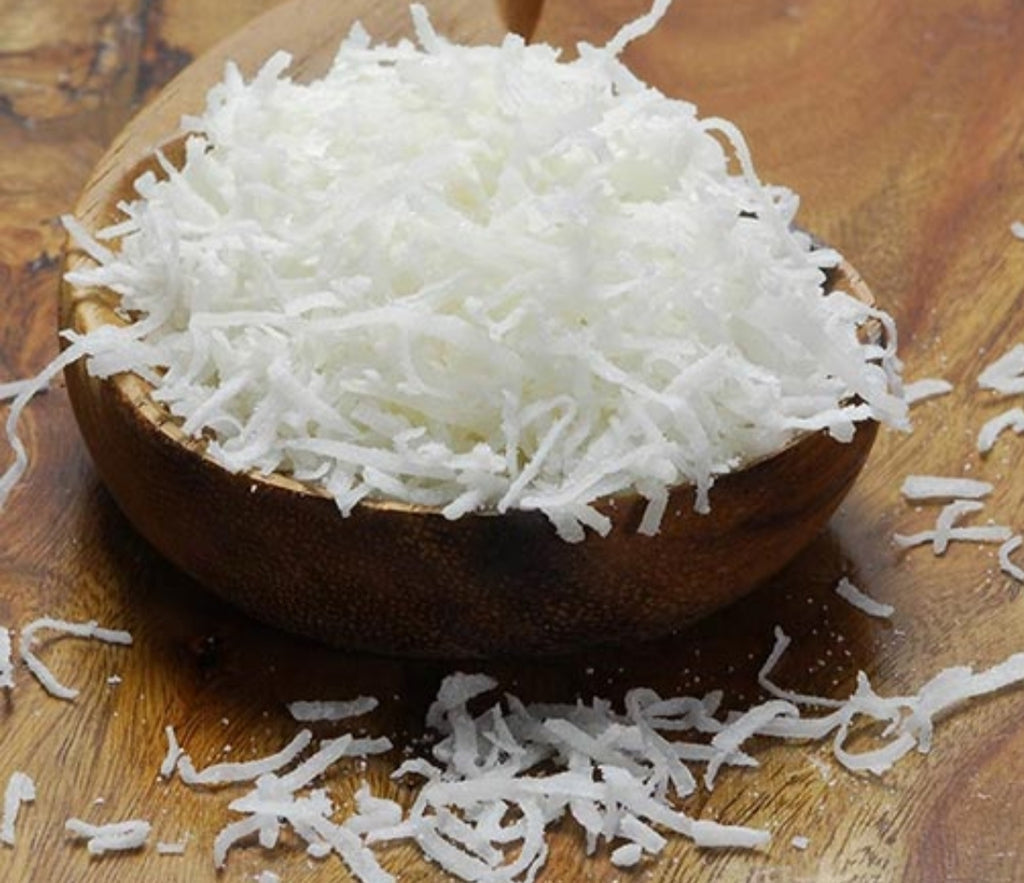
To ensure consistency across the global supply chain, organic desiccated coconut is categorized into distinct grades based on fat content and particle size. B2B buyers must select the precise grade that matches their final product formulation requirements. Below is a detailed technical specification table outlining standard commercial grades exported through our distribution networks.
| Parameter | High Fat Fine Grade | High Fat Medium Grade | Low Fat Fine Grade |
|---|---|---|---|
| Fat Content (%) | 63% ± 2% | 65% ± 2% | 45% ± 3% |
| Moisture Content | Max 3.0% | Max 3.0% | Max 3.5% |
| Free Fatty Acids (as Lauric) | Max 0.1% | Max 0.1% | Max 0.15% |
| SO2 (Sulfur Dioxide) | Free (0 ppm) | Free (0 ppm) | Free (0 ppm) |
| Color | Natural Milky White | Natural Milky White | Natural Milky White |
| Salmonella / 25g | Absent | Absent | Absent |
| E. coli / 1g | Absent | Absent | Absent |
6. International Certifications & Supply Chain Compliance
In the premium organic food sector, certifications are not optional; they are a fundamental regulatory requirement. Operating a global Organic Desiccated Coconut Distribute Channel demands complete adherence to international organic standards and strict food safety management systems. When vetting partners, global procurement officers must ensure suppliers possess the following key credentials:
- USDA Organic & EU Organic: These standard-bearer certifications prove that the coconut cultivation and processing lines strictly avoid synthetic inputs, GMOs, and irradiation. Full traceability must be documented via valid Transaction Certificates (TC) for every single shipment.
- HACCP & ISO 22000: These framework credentials demonstrate a systematic approach to food safety hazard control during processing, packaging, and handling.
- BRCGS (British Retail Consortium Global Standards): For enterprise food manufacturers and major supermarket chains, a BRC certification ensures that the processing facility meets the highest level of global safety, quality, and operational criteria.
- Kosher & Halal: Essential for broad market access, these religious certifications guarantee that the processing line does not cross-contaminate with non-compliant animal products or ingredients.
At VIHABA, our production streams are audited annually by world-class certification bodies. This rigorous compliance framework ensures that every batch of organic desiccated coconut delivered to your domestic port is pre-cleared for customs compliance and ready for immediate integration into your production processes.
7. B2B Packaging, Shelf-Life, and Shipping Logistics
Proper industrial packaging and strict atmospheric control during maritime transport are critical to preventing oxidation and moisture absorption, which can lead to oil rancidity and mold growth. As a result, maintaining product quality requires specialized packaging configurations and robust container management procedures.
Standard Industrial Packaging Options
- Multi-wall Kraft Paper Bags: Standard bulk packaging consists of a heavy-duty, multi-layer food-grade Kraft paper bag outer envelope with a high-density polyethylene (HDPE) inner liner. Standard weights are 25 kg or 50 lbs per bag.
- Jumbo Bulk Bags (FIBC): For high-volume automated manufacturing lines, we supply polypropylene Jumbo Bags ranging from 500 kg to 1,000 kg capacity, complete with custom bottom-spouts for easy discharging.
Container Loading & Transit Management
Desiccated coconut contains high natural fat percentages, making it sensitive to extreme heat. During maritime transport, we utilize dry, well-ventilated 20ft or 40ft General Purpose (GP) containers. To prevent thermal shock and container rain (condensation), we employ moisture-absorbent silica gel poles, cardboard lining on the container walls, and kraft paper underlays. Under optimal storage conditions (cool, dry environment below 25°C, away from strong odors and direct sunlight), the typical shelf life of organic desiccated coconut is 12 to 24 months.
9. Conclusion: Partnering with VIHABA for Global Supply Chain Excellence
Sourcing your agricultural ingredients through a dedicated and verified Organic Desiccated Coconut Distribute Channel is the absolute key to building a sustainable, safe, and cost-effective B2B supply chain. By managing the process directly from the organic groves of Ben Tre Province to state-of-the-art processing and worldwide shipping networks, VIHABA is uniquely positioned to serve as your long-term agricultural trading partner. Our commitment to strict international standards (USDA Organic, EU Organic, ISO 22000, Halal, Kosher) ensures that your business receives consistent, premium-grade ingredients with every shipment. Contact our international export desk today to request product samples, custom technical specifications, and tailored FOB or CIF quotations.