Understanding the exact Turmeric Powder Curcumin Specs & Culinary Facts is absolutely essential for spice importers, R&D food scientists, and industrial seasoning buyers who need to specify the exact technical grade for their production lines. Unlike culinary herbs judged purely on aroma, commercial Curcuma longa powder is priced and formulated based on measurable laboratory specifications: curcuminoid concentration, volatile turmerone oil content, and particle mesh dispersion, all of which dictate how vibrantly the powder colors a food matrix and how smoothly it integrates into sauces, batters, and beverages.
For international procurement teams and supply chain managers looking to capitalize on this global commodity, reviewing the operational logistics of the wholesale supply chain is the mandatory next strategic step. However, before executing bulk contracts, buyers must fully understand the pigment chemistry, milling physics, and culinary performance metrics that separate premium export-grade turmeric powder from dull, starch-diluted dust.
Table of Contents
-
The Chemical Matrix: Curcuminoids and Volatile Turmerones
-
Milling Science: Cool-Grinding and Mesh Dispersion
-
Sensory Profile: Essential Turmeric Powder Curcumin Specs & Culinary Facts
-
Quality Benchmarks and Adulteration Screening
-
Wholesale Spice Integration

The Chemical Matrix: Curcuminoids and Volatile Turmerones
When analyzing the commercial value of export-grade turmeric powder, the primary quality metric is the percentage of curcuminoids—the natural polyphenolic pigments responsible for both its luminous yellow-orange hue and its anti-inflammatory wellness properties.
Commercial export turmeric powder is segmented into clear curcumin tiers: 2.5%–3.5% for standard culinary applications (curry blends, pickles, rice seasonings), and 4.5%–5.5%+ for high-color natural food dyes and nutraceutical formulations. Alongside curcuminoids, authentic un-extracted turmeric powder contains 2.5%–4.5% volatile essential oils (predominantly ar-turmerone), which deliver the spice’s signature warm, earthy, slightly peppery-gingery aroma.

Milling Science: Cool-Grinding and Mesh Dispersion
A critical element within the manufacturing cycle is controlling friction heat during grinding and achieving uniform particle size distribution (measured in US Standard Mesh).
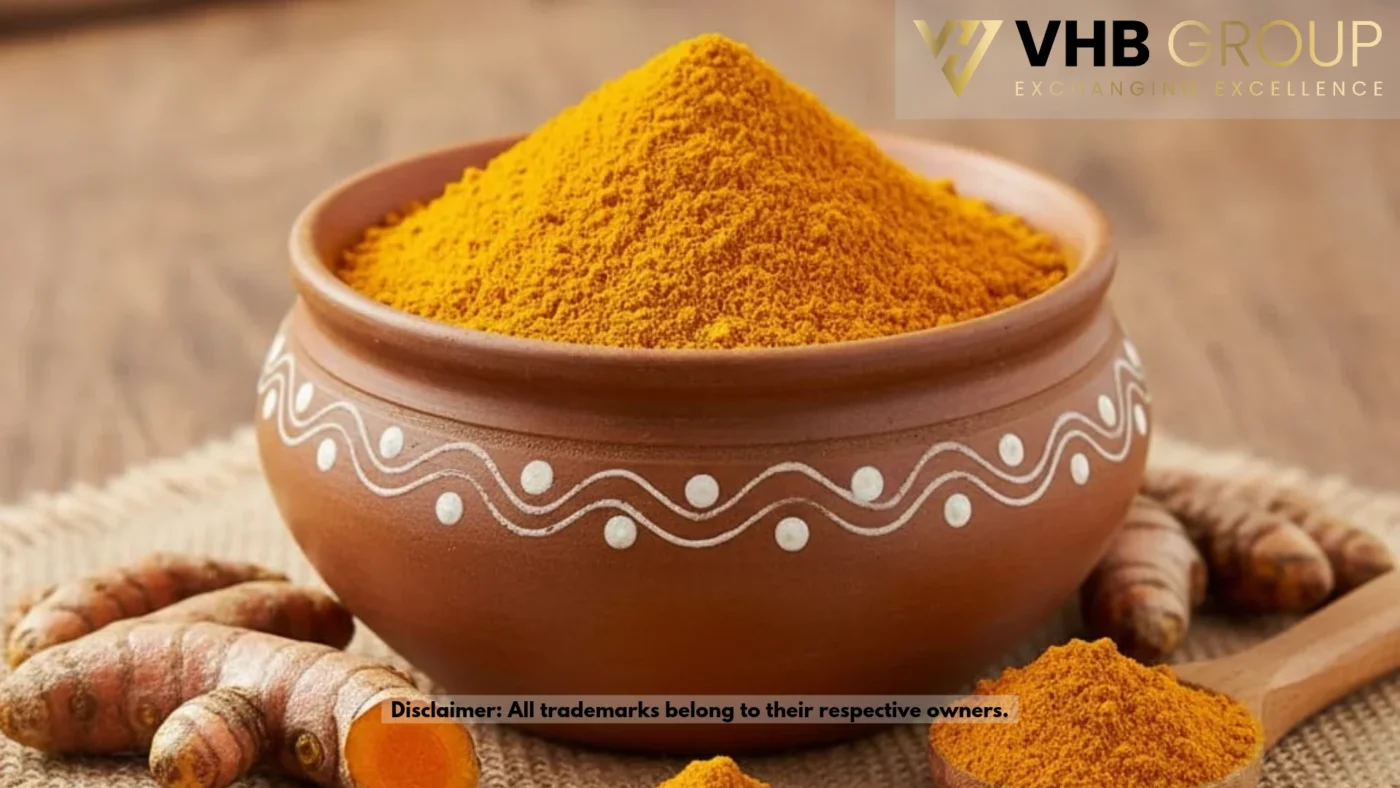
View Turmeric Powder and Roots Reference on Wikimedia Commons
Because turmeric rhizomes are dense and rich in natural starch and oleoresins, standard high-heat hammer-milling can scorch the powder—shifting its bright golden-yellow pigment toward a dull brownish-orange and flashing off volatile turmerones. Premium export mills utilize cool-grinding or cryogenic milling systems that keep grinding temperatures low, preserving maximum natural color brightness and aromatic oil content.
Standard Industrial Mesh Specifications
-
60–80 Mesh (Standard Fine): The global workhorse for commercial curry powders, savory rubs, mustard, and retail spice jars—offering free-flowing handling without excessive dust.
-
100–120 Mesh (Ultra-Fine): Engineered for ready-to-drink (RTD) golden milk lattes, instant soup bases, and nutraceutical capsules where rapid dispersion and zero gritty sediment are mandatory.
Sensory Profile: Essential Turmeric Powder Curcumin Specs & Culinary Facts
The most distinctive physical characteristic of high-grade turmeric powder upon opening a freshly sealed PE-lined sack is its luminous, velvety saffron-gold to deep amber-orange hue and an immediate, warm, earthy aroma with subtle citrus-woody notes.
Balancing Color Strength, Earthiness, and Bitterness
The Turmeric Powder Curcumin Specs & Culinary Facts matrix is defined by clean coloring power without harsh bitterness. Curcumin is naturally fat-soluble; in culinary applications (such as curries, sauces, and baked goods), blooming turmeric powder in oil or dairy fats unlocks its deepest golden color and rounds out its earthy flavor. Inferior powders milled from spent (oleoresin-extracted) rhizomes or diluted with cornstarch exhibit weak coloring power, a chalky mouthfeel, and a flat, dusty aroma.

Quality Benchmarks and Adulteration Screening
To fully grasp the commercial appeal and pass strict international border inspections, B2B buyers must specify exact laboratory parameters on their Certificate of Analysis (COA).
| Quality Parameter | Standard Export Specification | Functional Significance |
| Curcumin Content | 3.0% – 5.5%+ (ASTA / HPLC) | Primary pricing driver for coloring strength and wellness potency. |
| Moisture Content | ≤ 10.0% | Prevents caking, clumping, and mold/aflatoxin growth during transit. |
| Total Ash / Acid-Insoluble | ≤ 8.0% / ≤ 1.5% | Verifies thorough washing and absence of soil or mineral fillers. |
| Lead & Synthetic Dyes | Zero Lead Chromate / Zero Sudan | Mandatory FDA and EU border safety screening against adulteration. |
Wholesale Spice Integration
Mastering the core curcumin specifications and milling physics is the definitive key to sourcing high-performing turmeric powder for industrial applications. By specifying cool-milled 60–80 mesh or 100-mesh grades with verified HPLC curcumin assays and strict heavy-metal clearance, international distributors and food manufacturers guarantee vibrant, consistent performance across every production batch.