
Sourcing Refined Coconut Oil Bulk inventory provides international B2B food manufacturers, oleochemical refiners, commercial bakeries, and personal care formulators with a versatile, heat-stable, neutral plant-oil commodity. Processed through industrial Refining, Bleaching, and Deodorizing (RBD), Refined Coconut Oil offers an odorless, flavorless, and water-clear appearance in its liquid state. Its exceptionally high smoke point of 232°C (450°F) makes it an essential choice for high-volume commercial food production, deep frying, and industrial cosmetic applications.
For B2B procurement directors and supply chain managers at VHB Group, procuring full container load (FCL) consignments of bulk RBD coconut oil requires evaluating complex technical parameters. Procurement teams must navigate free fatty acid (FFA) thresholds, peroxide value limits, bulk container selection (Flexitanks vs. Drums), thermal phase-change logistics, and international food safety compliance. This technical guide evaluates the operational, chemical, and logistical protocols necessary to build a resilient, cost-effective, and fully compliant supply chain.
Table of Contents
-
Global Industrial Demand and Commercial Applications
-
The Industrial Refining Process: Degumming, Bleaching, and Deodorization
-
Chemical Composition and Quality Specifications Matrix
-
Bulk Packaging Logistics: Flexitanks, IBC Totes, and Steel Drums
-
B2B Landed Cost and Yield Calculation Framework
-
Regulatory Compliance, Food Safety, and Customs Clearance
-
Frequently Asked Questions (FAQ)

1. Global Industrial Demand and Commercial Applications
Refined Coconut Oil serves as a foundational structural fat across three main global industries:
Commercial Food Processing and Confectionery
In the commercial food sector, RBD coconut oil is favored because it provides a non-hydrogenated, trans-fat-free saturated fat base. It acts as an ideal cocoa butter replacer (CBR) in chocolate coatings, a spray fat for crackers and biscuits, a stable frying oil for snack foods, and a creaming fat in plant-based dairy alternatives like vegan cheeses and non-dairy creamer powders. Because the deodorization process removes all natural coconut scent and flavor, it does not alter the intended taste profile of finished food products.
Cosmetics, Personal Care, and Beauty Products
Cosmetic formulators utilize refined coconut oil as a neutral, non-staining emollient base. It provides deep moisturizing properties without leaving a heavy, greasy residue or imparting an unwanted tropical scent. It is widely used in high-end soaps, body lotions, liquid foundations, lipsticks, and hair conditioners.
Oleochemicals and Pharmaceutical Compounding
In the chemical and pharmaceutical sectors, bulk RBD coconut oil is used as a feedstock for synthesizing fatty acids, fatty alcohols, glycerol, and medium-chain triglyceride (MCT) fractions. These derivatives are processed into natural surfactants, industrial lubricants, personal care emulsifiers, and medical-grade nutritional supplements.
2. The Industrial Refining Process: Degumming, Bleaching, and Deodorization
Unlike unrefined virgin coconut oil, which is cold-pressed from fresh coconut meat, Refined Coconut Oil is extracted from dried copra and undergoes a systematic multi-stage industrial refining process to remove free fatty acids, color bodies, and volatile aromatic compounds.
Degumming and Neutralization
Crude coconut oil extracted from copra contains gums, phospholipids, and free fatty acids. Food-grade phosphoric acid is introduced to bind and separate phosphatides (gums). Sodium hydroxide is then added to neutralize free fatty acids, converting them into insoluble soapstock that is mechanically separated via industrial centrifuges.
Adsorptive Bleaching
The neutralized oil passes into bleaching tanks mixed with activated bleaching earth (bentonite clay) and activated carbon under vacuum. This step absorbs natural carotenoids, chlorophyll, oxidation products, and trace heavy metal contaminants, turning the dark crude oil into a pale yellow liquid.
High-Vacuum Thermal Deodorization
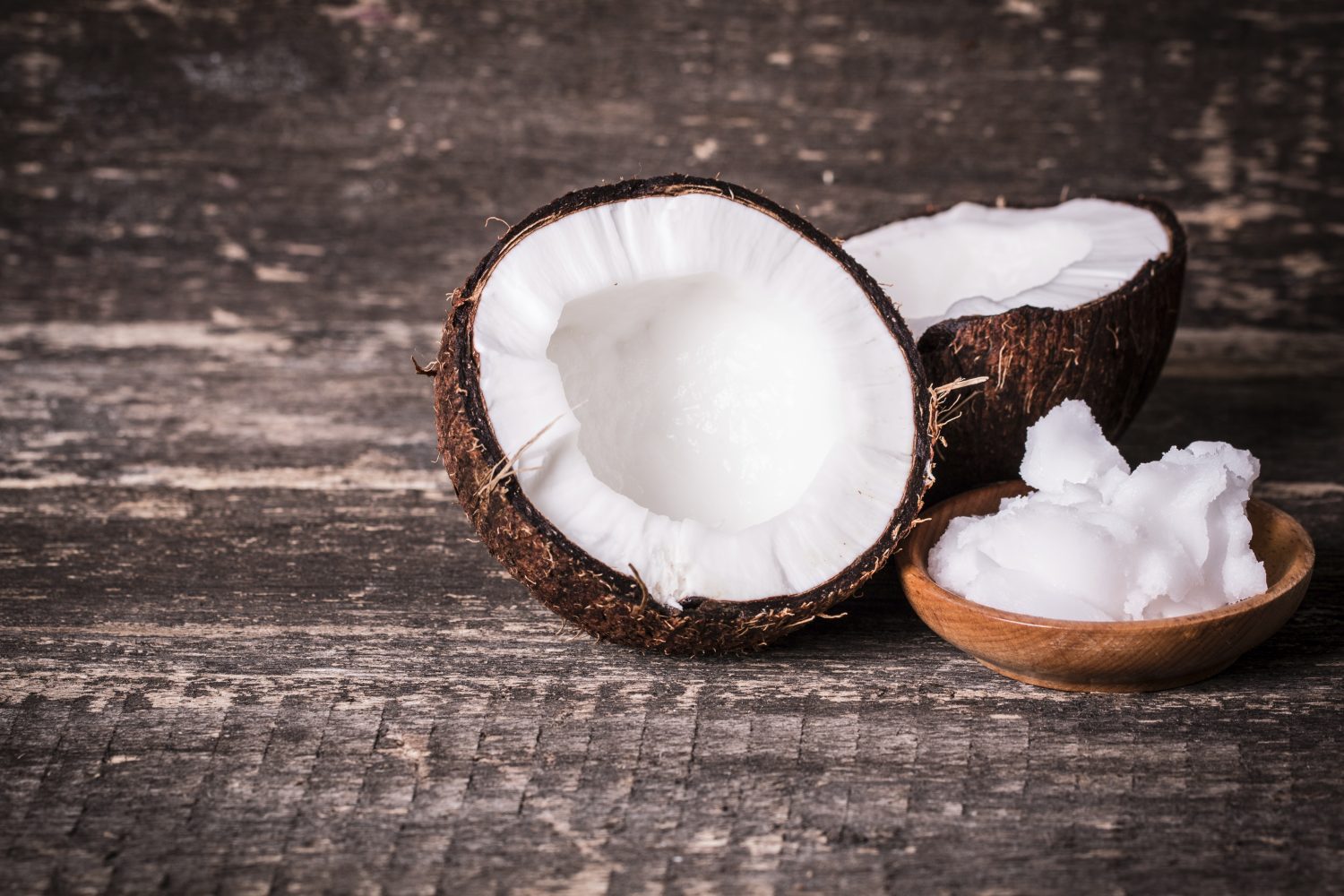
The bleached oil undergoes high-temperature steam distillation under high vacuum (200°C to 240°C). Superheated steam strips away remaining volatile aldehydes, ketones, and residual free fatty acids responsible for taste and odor. The resulting liquid is water-clear above 25°C (77°F) and solidifies into a clean, stark-white fat below 24°C (75°F).
3. Chemical Composition and Quality Specifications Matrix
To comply with International Organization for Standardization (ISO 22537) and Codex Alimentarius standards, wholesale consignments of RBD coconut oil supplied by VHB Group adhere to strict analytical thresholds:
| Quality Parameter | Technical Benchmark | Functional Industrial Impact |
| Free Fatty Acid (as Lauric) | Maximum 0.05% to 0.10% | Ensures exceptional oxidative stability and a neutral palate. |
| Moisture & Volatile Matter | Maximum 0.05% | Prevents hydrolytic breakdown and extends shelf storage. |
| Peroxide Value (PV) | Maximum 0.5 to 1.0 meq/kg | Confirms pristine, unoxidized initial quality. |
| Iodine Value (IV) | 7.5 to 10.5 g I2 / 100g | Verifies high saturation level and thermal frying stability. |
| Color (Lovibond 5.25″ Cell) | Max 1.0 Red / 10 Yellow | Guarantees water-clear appearance in its liquid state. |
| Melting Point Range | 24°C to 26°C (75°F to 78°F) | Governs physical state during warehousing and shipping. |
| Smoke Point | 232°C (450°F) | High thermal threshold suitable for commercial deep frying. |
4. Bulk Packaging Logistics: Flexitanks, IBC Totes, and Steel Drums
Selecting the appropriate bulk packaging container directly impacts freight density, labor handling expenses, and landed unit costs.
Ocean Flexitanks (20ft Dry FCL)
Flexitanks are multi-layer, food-grade polyethylene bladders installed inside standard 20ft ocean dry containers.
-
Payload Yield: 21,000 to 22,000 Liters (approximately 19.3 to 20.2 Metric Tons).
-
Advantages: Delivers the highest volumetric payload yield per container, eliminating drum disposal and handling labor.
-
Operational Considerations: Requires bottom heating pads at destination ports if shipping to cold climates where the oil solidifies in transit.
Intermediate Bulk Containers (IBC Totes – 1,000L)
Heavy-duty paperboard IBC totes or rigid plastic-cage totes fitted with food-grade inner liners.
-
Payload Yield: 18 to 20 totes per 20ft FCL (18,000 to 20,000 Liters / 16.5 to 18.4 Metric Tons).
-
Advantages: Excellent choice for mid-sized cosmetics factories equipped with tote-tilting discharge equipment.
HDPE and Steel Drums (200L / 55 Gallon)
Standard tight-head or open-top food-grade drums arranged on wooden pallets.
-
Payload Yield: 80 drums per 20ft FCL (approximately 16,000 Liters / 14.7 Metric Tons).
-
Advantages: Highly accessible for smaller production runs; easily melted in batch hot-rooms.
5. B2B Landed Cost and Yield Calculation Framework
Evaluating total procurement costs across ocean transport routes requires accounting for freight fees, import tariffs, and decanting overhead. Procurement officers utilize a structured calculation process:
-
Step 1: Calculate Total Shipping Overhead = Ocean Freight Charges + Import Customs Duties + Marine Insurance Premiums + Local Port Drayage.
-
Step 2: Calculate Destination Decanting/Heating Costs = Low-Pressure Hot-Water Heating Pad Rentals + Factory Melting Labor.
-
Step 3: Calculate Net Usable Mass = Total Shipped Mass x (1 – Unload Residual Loss Percentage), where residual oil clinging to flexitank walls or drum liners typically ranges from 0.5% to 1.0%.
-
Step 4: Calculate Net Landed Cost per Usable Metric Ton = (Total FOB Factory Purchase Value + Total Shipping Overhead + Destination Decanting Costs) / Net Usable Mass.
Modeling these financial variables ensures procurement managers accurately project margin retention before releasing purchase orders.
6. Regulatory Compliance, Food Safety, and Customs Clearance
Clearing international customs without administrative delays requires complete compliance documentation verified by accredited origin laboratories.
Essential Export Documentation Suite
-
Commercial Documentation: Master Bill of Lading (B/L), Commercial Invoice, Detailed Packing List, and Certificate of Origin (COO).
-
Quality & Safety Certificates: Batch Certificate of Analysis (CoA), ISO 22000 / HACCP Verification, Halal (MUIS/JAKIM) Certification, and Kosher Certification.
-
Customs Tariff Classification: Classified under HS Code 1513.19.00 (Refined coconut oil and its fractions).
Bulk Refined Coconut Oil Procurement FAQ
Disclaimer: Unless otherwise stated, the images used in this article are the property of their respective owners. We do not claim ownership of any third-party images featured, and they are used here strictly for informational and educational purposes. If you are the copyright holder and wish to have an image removed, please contact us.